Commissioner Andrius Kubilius visits Destinus to discuss Bliksem EXO and Europe’s missile defence
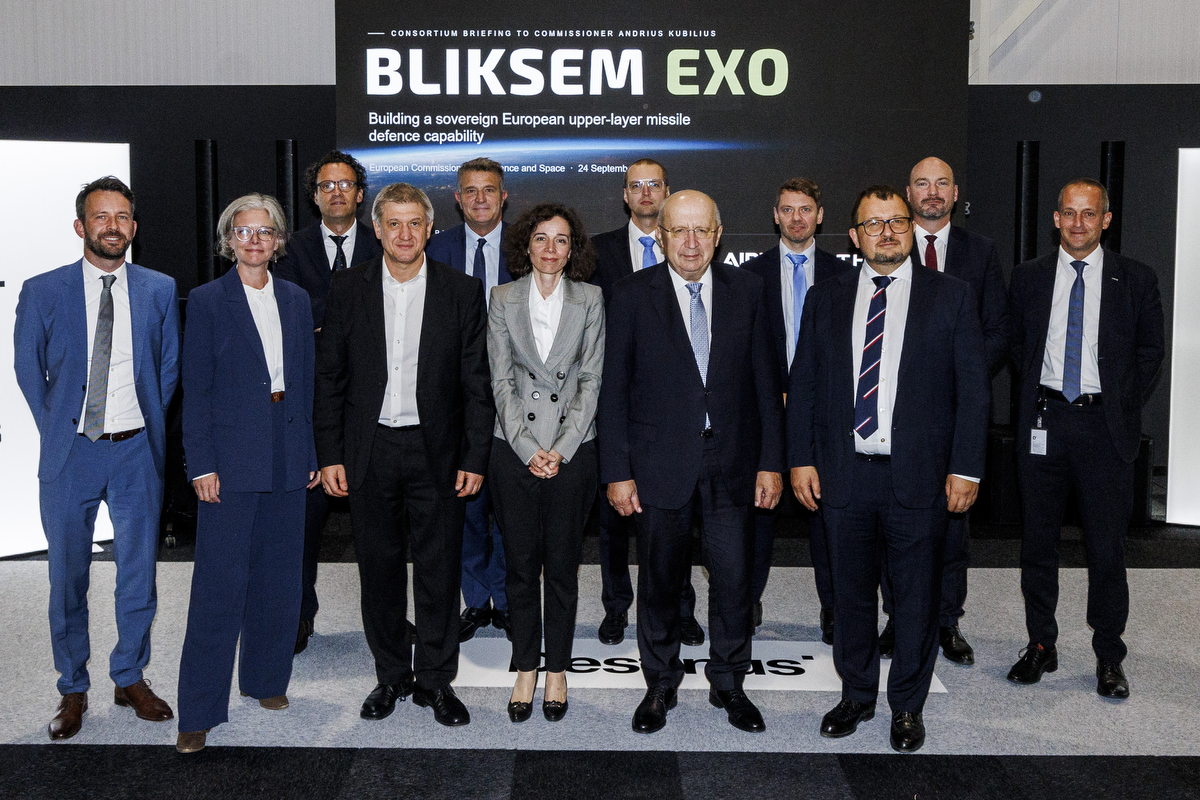
The European Commissioner for Defence and Space met the industrial partners behind Bliksem EXO to discuss Europe’s upper-layer missile-defence requirements, cross-border industrial cooperation and the development of a sovereign European interceptor system.
Europe’s missile-defence architecture depends on several layers working together against very different classes of threat.
Bliksem EXO is being developed for the upper layer: medium- and intermediate-range ballistic missile threats that require interception above the atmosphere, complementing existing and planned lower-layer air- and missile-defence systems.
On 24 September, European Commissioner for Defence and Space Andrius Kubilius visited Destinus in the Netherlands for a working session with representatives of the industrial partners behind Bliksem EXO.
The discussion focused on the program roadmap, Europe’s missile-defence requirements and the industrial cooperation needed to develop and produce such a capability in Europe.
“Europe’s security requires both technological innovation and industrial capacity to deliver critical capabilities quickly and reliably,” said European Commissioner for Defence and Space Andrius Kubilius.
Building the upper layer in Europe
Bliksem EXO brings together five European defence and aerospace companies.
In July 2026, Airbus Defence and Space, Destinus, MBDA Deutschland, Safran Electronics & Defense and Thales signed a Letter of Intent to establish the Bliksem EXO Consortium.
Under the framework announced at the time, Destinus serves as Consortium Lead and Prime. Across the partnership, the companies bring complementary capabilities spanning interceptor technology, propulsion and launch systems, guidance and sensing, battle management, radar and system integration.
The aim is not simply to develop another interceptor. An upper-layer missile-defence capability depends on the whole system working together: sensors, battle management, interceptor, guidance, launch architecture and the industrial capacity to manufacture and support it.
That is what makes the industrial model behind Bliksem EXO as important as the interceptor itself.
“Europe needs the ability to develop and industrialise critical missile-defence capabilities on its own industrial base,” said Mikhail Kokorich, CEO of Destinus. “Bliksem EXO is built around that principle: European partners combining complementary technologies in one interoperable upper-layer system.”
Part of a layered missile-defence architecture
Bliksem EXO is conceived as a sovereign European interceptor system against medium- and intermediate-range ballistic missile threats.
The proposed system is designed for interoperability with NATO Integrated Air and Missile Defence (IAMD) and to contribute to the European Sky Shield Initiative (ESSI).
That positioning matters. Bliksem EXO is not intended to replace existing air- and missile-defence systems. It is designed to add an upper layer to the architecture, operating above the atmosphere against threat classes that require a different interception regime.
The result is a layered approach in which different systems address different parts of the threat spectrum while remaining connected through a wider defence architecture.
From industrial agreement to a working program
The July Letter of Intent set out the partners’ intentions for the development, qualification, industrial-scale production and long-term support of Bliksem EXO.
The Commissioner’s visit gave the industrial team an opportunity to present the roadmap directly and discuss the technical and industrial conditions required to move the program forward.
For Destinus, Bliksem EXO also reflects a broader principle: Europe’s defence gaps cannot be addressed by technology alone. They require engineering, integration and industrial capacity to move together.
The challenge is not simply to demonstrate that a system can work. It is to build a European industrial architecture capable of developing, qualifying, producing and supporting it at the scale required.
That is the work now underway around Bliksem EXO.